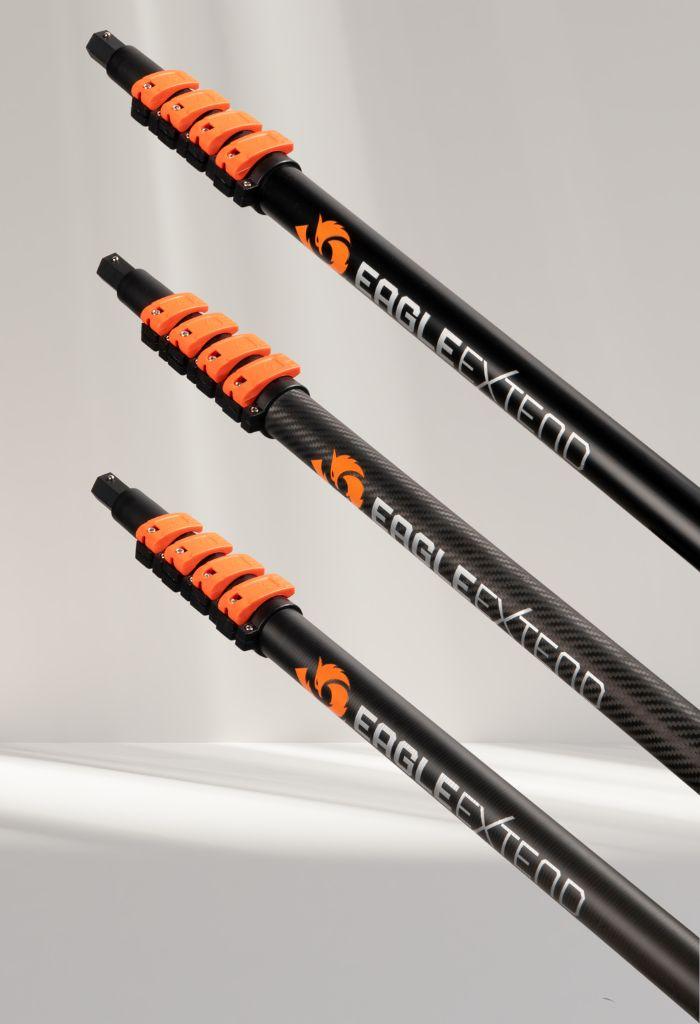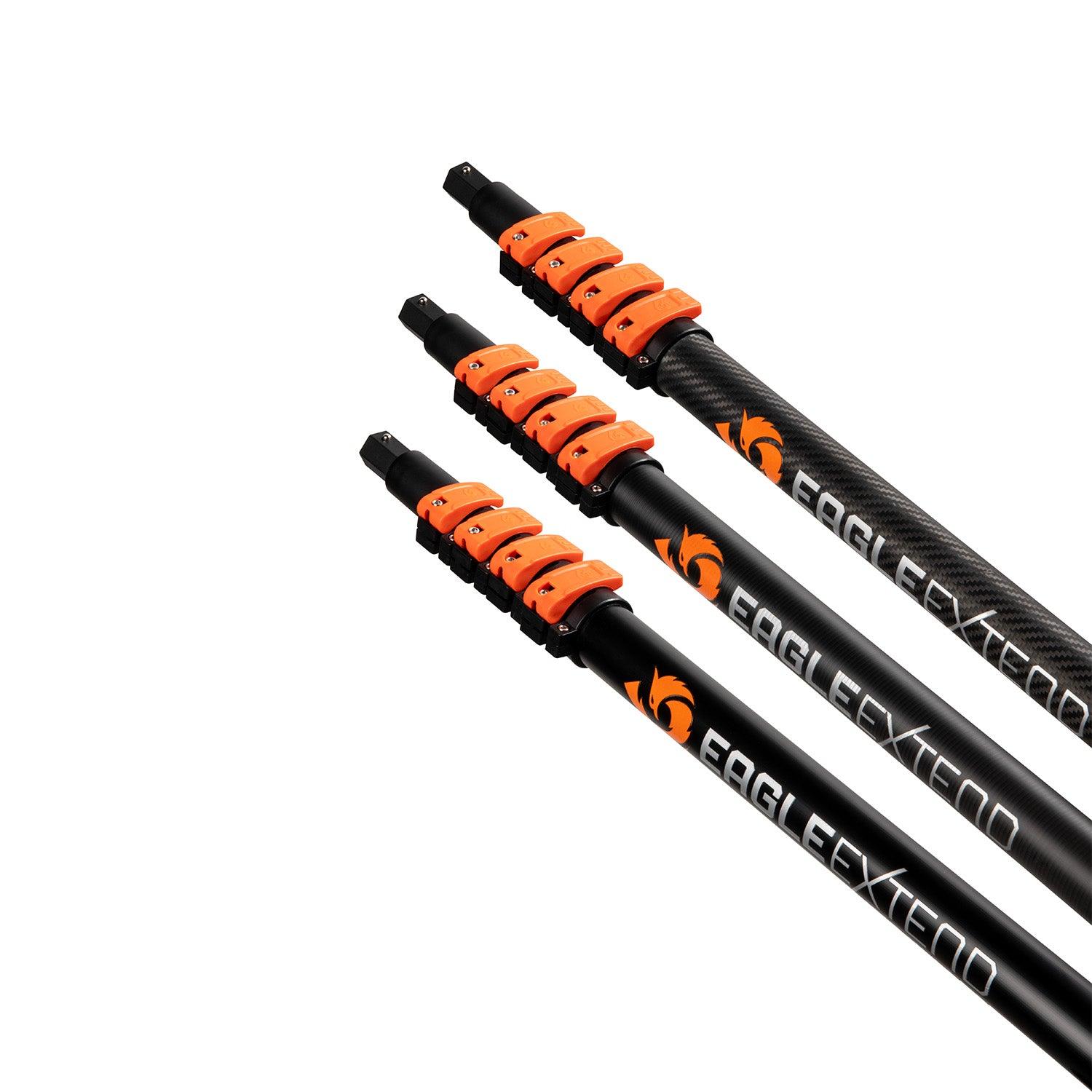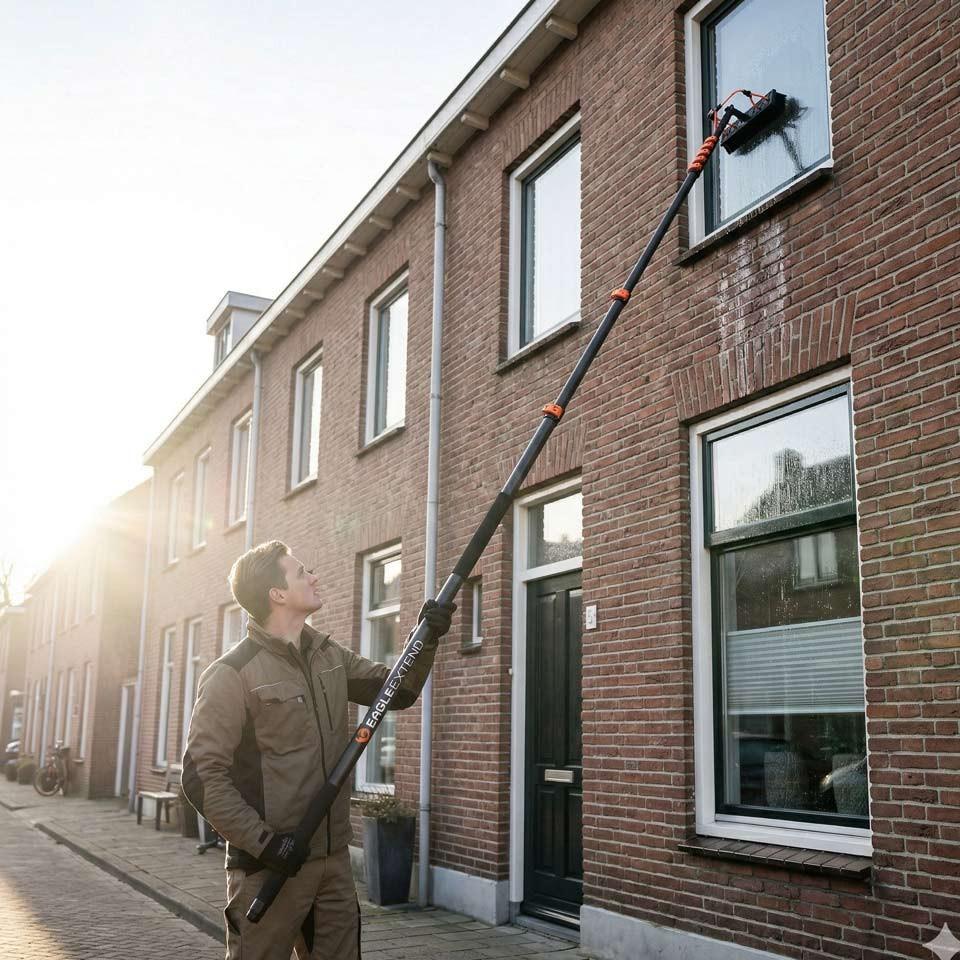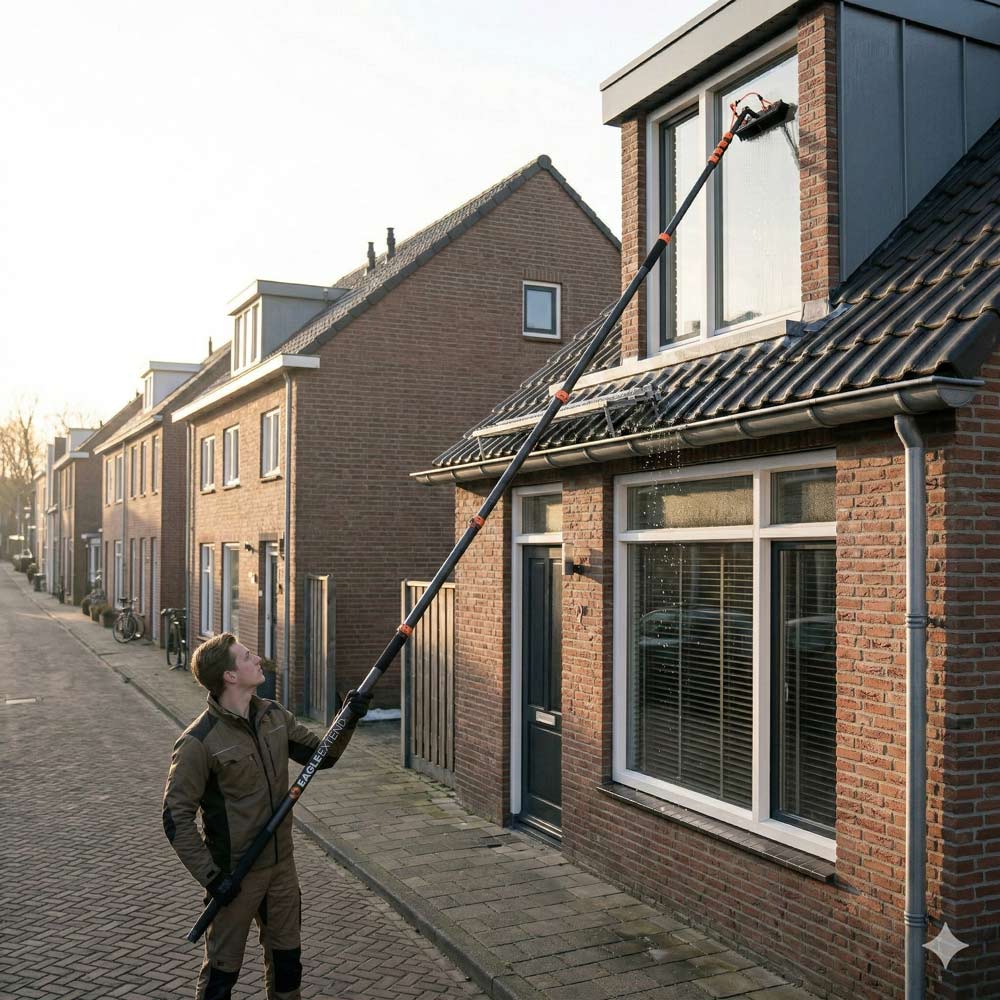
The water-fed pole you need is the shortest one whose working length reaches your highest window once you add your own reach and allow for the angle you stand at. For upstairs windows on most houses that means a 5.5 m (18 ft) pole; for windows two floors up, dormers and solar panels, 7.5 m (24.6 ft) or longer.
A pole that’s just too short is the most common buying mistake. A pole that’s far too long is the second: heavier than it needs to be, awkward to store and hard to fit in the car. Below you’ll find a simple way to calculate the right length, rough storey heights as a rule of thumb, and our advice for the most common jobs. All figures are estimates — every house is different — but this method rarely leaves you more than one size out.
Nominal length or working length: which one counts?
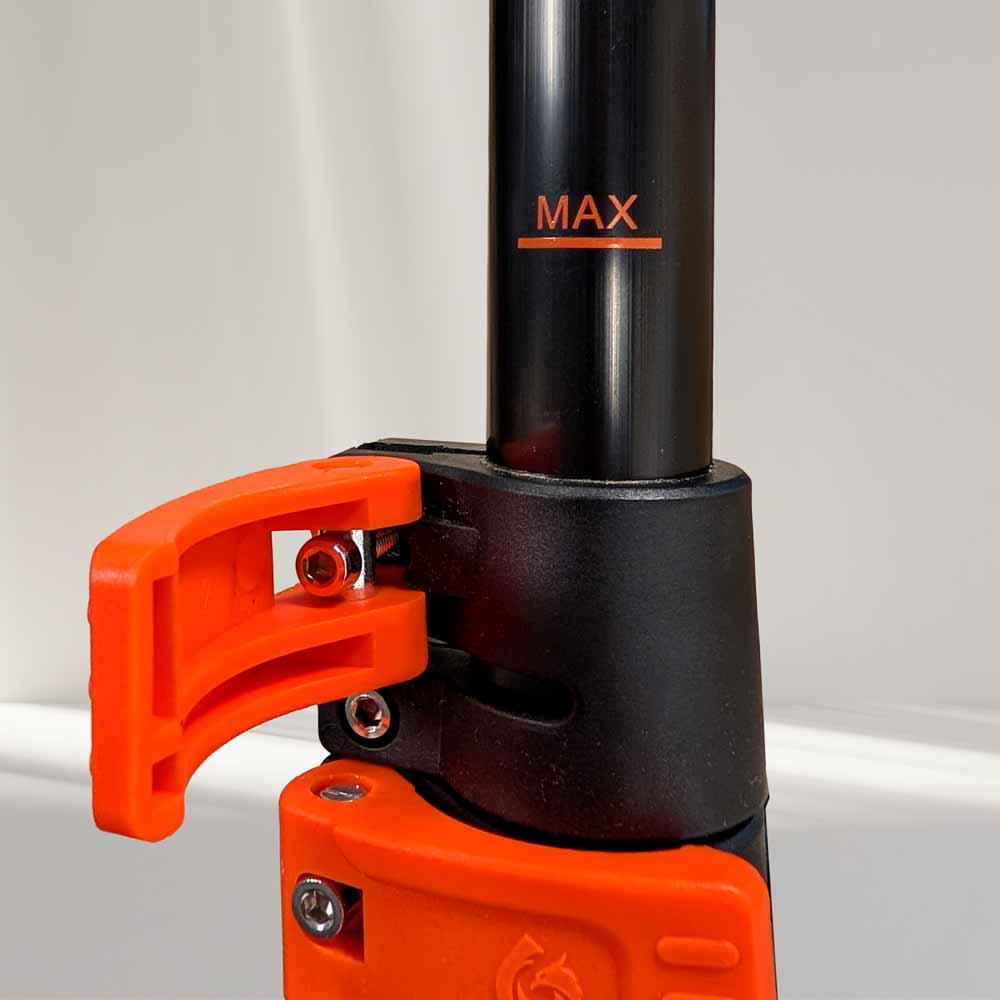
The figure in the product name is the nominal length: all sections added together. You never reach it in practice, because the sections overlap and you only extend each one as far as its red MAX mark. What’s left is the working length — and that’s the only number to calculate with.
| Pole | Working length | Retracted |
|---|---|---|
| Aluminum Supreme 3.5 m (11.5 ft) | 3.1 m | 1.08 m |
| Aluminum Supreme 5.5 m (18 ft) | 5.1 m | 1.56 m |
| Aluminum Supreme 7.5 m (24.6 ft) | 7.1 m | 1.73 m |
| Aluminum Supreme / carbon 9 m (29.5 ft) | 8.5 m | 2.02 m |
| Aluminum Supreme / carbon 10.2 m (33.5 ft) | 9.8 m | 2.26 m |
| Carbon Fiber / 3K Full Carbon 12.05 m (39.5 ft) | 11.5 m | 2.26 m |
Swipe sideways to see the whole table →
The difference looks small — 40 to 55 cm — but that’s exactly the bit that decides whether you reach the top of a window or not. For what each model reaches in practice, see the reach table in how to clean upstairs windows without a ladder. Here we go a step further: how to work out the right size for your own house.
The calculation in four steps
How to find the working length you need
- 1Find your highest point
Take the highest point you want to clean: the top of the highest window, the underside of the gutter or the top row of solar panels. A laser measure is the most accurate; an estimate based on storey height (see below) also works.
- 2Subtract your own reach
You don’t hold the pole at ground level but roughly at chest height. For an adult, allow about 1.5 m. The pole doesn’t have to cover that part.
- 3Allow for the angle
You almost never stand right against the wall. A flower bed, a bike shed, a bay window or simply the room you need to look up: you’re soon 1.5 to 3 m away. The pole then leans at an angle — and a sloping line is always longer than the straight height.
- 4Add some spare length
You want to place the brush just above the top edge without working at full stretch. Add half a metre. Then pick the model whose working length is equal to or greater than your result.
Worked example: an upstairs window
Say the top of your bedroom window is at 5.5 m. Take off 1.5 m for your reach, and the pole has to cover 4 m vertically. You stand 2 m from the wall because of a flower bed. Pythagoras gives you the sloping length: √(4² + 2²) = √20 ≈ 4.5 m. Add half a metre spare and you need 5 m of working length — so an Aluminum Supreme 5.5 m pole (working length 5.1 m) is just right.
If an extension or a wide border means you have to stand 3 m back, it becomes √(4² + 3²) = 5 m, or 5.5 m with spare. That’s beyond the 5.5 m pole, so you’d need the 7.5 m. This shows what the angle costs: one extra metre of distance can mean a whole size up.
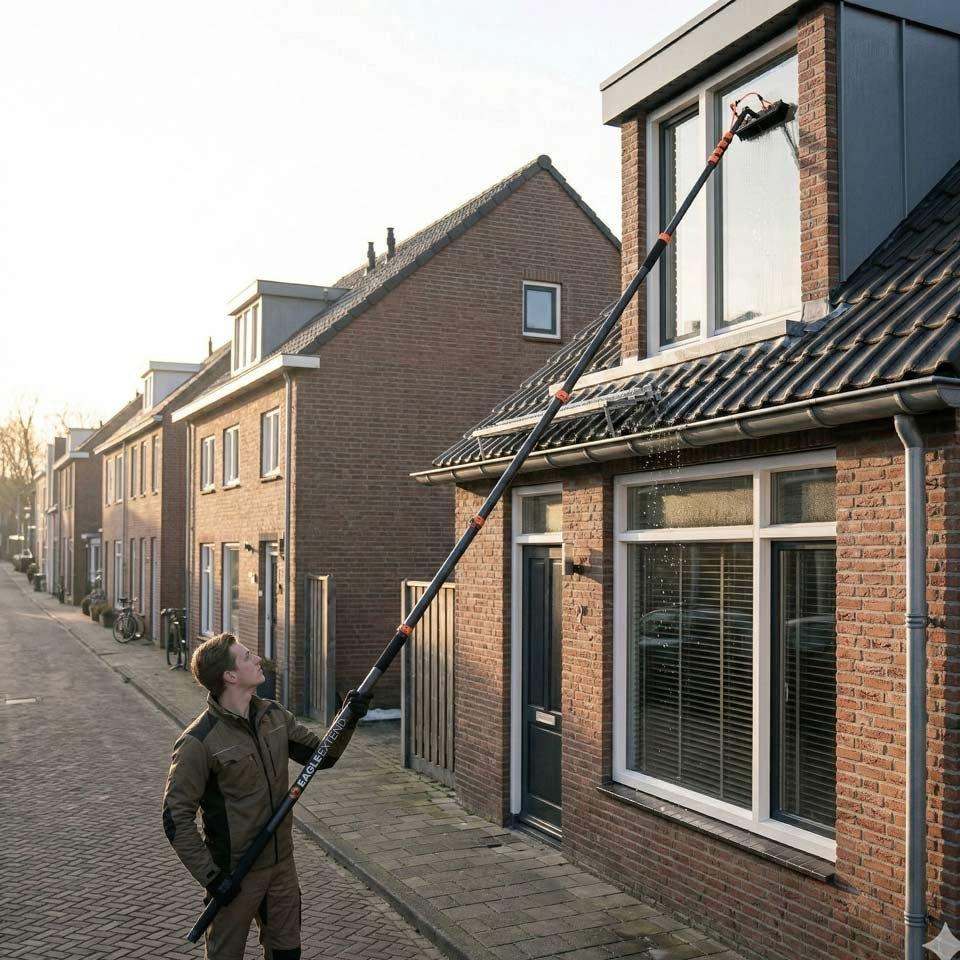
How high are your windows, gutter or dormer?
If you’d rather not measure, you can estimate. As a rule of thumb, each storey is roughly 2.5 to 3 m higher than the one below; older houses with high ceilings sit at the top of that range, newer homes often at the bottom. That gives these rough figures:
- Ground floor, conservatory, patio doors Top of the windows usually between 2 and 3.5 m.
- Upstairs windows (one floor up) Top of the windows roughly 5 to 6 m.
- Gutter on a two-storey house Often somewhere around 5.5 to 6.5 m.
- Dormer and windows two floors up The top is soon around 8 m — and with a dormer you also stand further back from the wall.
Recommended length by job
Combining the calculation with these storey heights gives the recommendations below. They assume you stand 1.5 to 2 m from the wall. If you have to stand further back, go one size up.
| Job | Highest point (roughly) | Recommended pole | Material |
|---|---|---|---|
| Ground floor, conservatory | 2–3.5 m | 3.5 m (working length 3.1 m) | Aluminium |
| Upstairs windows | 5–6 m | 5.5 m (5.1 m) | Aluminium |
| Dormer | 7–8 m | 7.5 m (7.1 m); set far back: 9 m | Aluminium or carbon |
| Windows two floors up | about 8 m | 7.5 m if you can stand close, otherwise 9 m | Aluminium or carbon |
| Solar panels on a pitched roof | gutter height + about 2 m | 7.5 m for the lower rows; 9–12.05 m for the top rows | Carbon recommended |
| Tall commercial building | up to about 12 m | 10.2–12.05 m | Carbon / 3K Full Carbon |
Swipe sideways to see the whole table →
With solar panels on a pitched roof you’re not working up a wall but up the roof slope, so you add extra length from the gutter. From 9 m, poles come with the extended XXL angle adapter as standard, which adds clearance between pole and panel. Planning to do every upstairs window in one go? Have a look at cleaning high windows too.
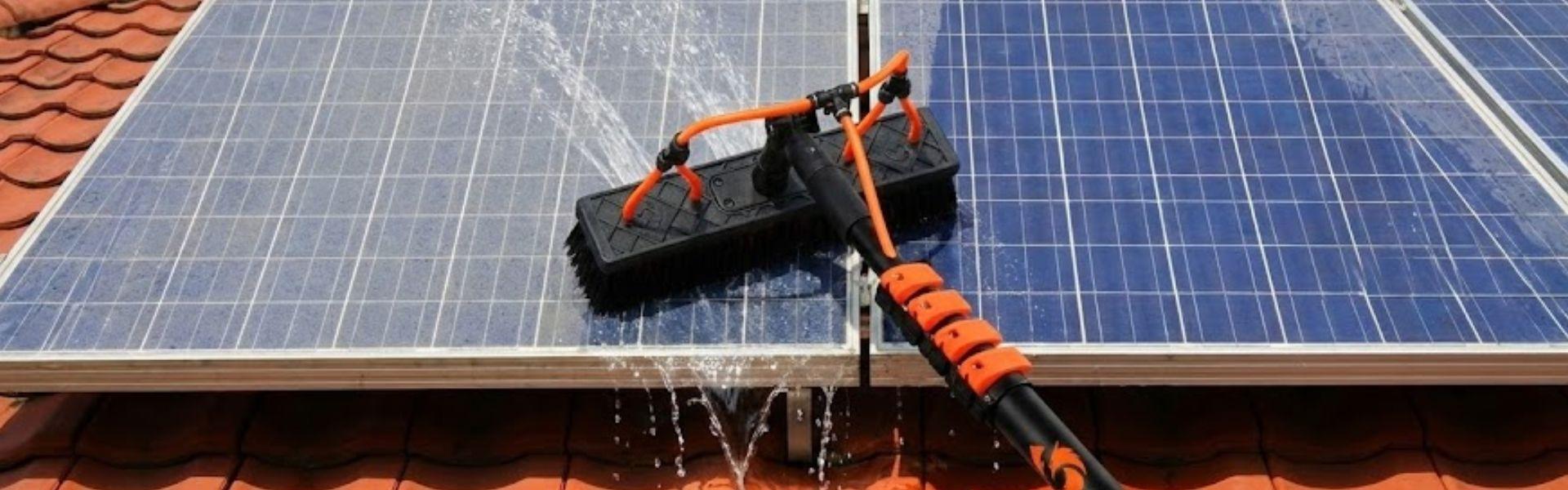
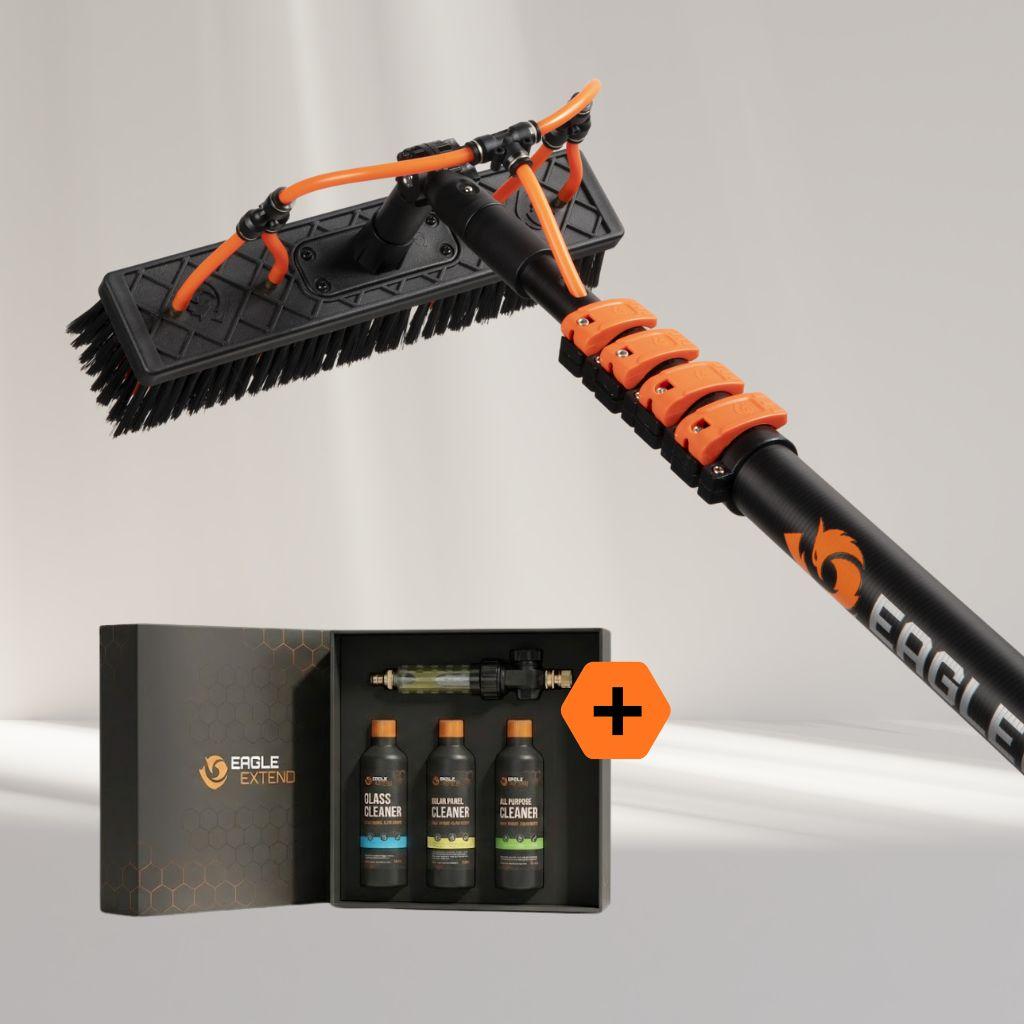
Aluminum Supreme Water-Fed Pole
Five lengths from 3.5 to 10.2 m (working length 3.1–9.8 m), weighing 1.7–3.9 kg. HexaLock® end adapter, SureLock™ clamps and AlignTrack™ V-groove. Includes a 4-Jet wash brush and a 5-year guarantee.
Why not just buy the longest pole?
You can always retract a pole, so why not buy the longest one? Because a longer pole has drawbacks even when you don’t extend it fully:
- Weight The Aluminum Supreme goes from 1.7 kg (3.5 m) to 3.9 kg (10.2 m). You carry that weight even when the pole is half extended. With the 3K Full Carbon the gap is smaller: 1.6 to 2.3 kg from 9 to 12.05 m.
- Retracted length Fully retracted, the poles measure from 1.08 m (3.5 m model) to 2.26 m (10.2 and 12.05 m). At 1.08 m a pole fits in any car boot or cupboard; at 2.26 m you’ll want a shed, a garage or a wall hook set.
- Handling at low height For the conservatory or ground-floor windows a long pole is unwieldy: even retracted it’s over 2 m, and you carry the extra weight for nothing.
- Delivery Long poles count as long freight, so the courier can vary with the length of the pole.
So the rule is: choose the shortest pole whose working length reaches your highest point with a little to spare. If you’re right between two sizes, take the longer one — you can’t extend a pole later, because each one is designed as a complete system. Above 7 m, material matters too: carbon flexes less and feels lighter in your arms. We explain the difference in aluminium or carbon.
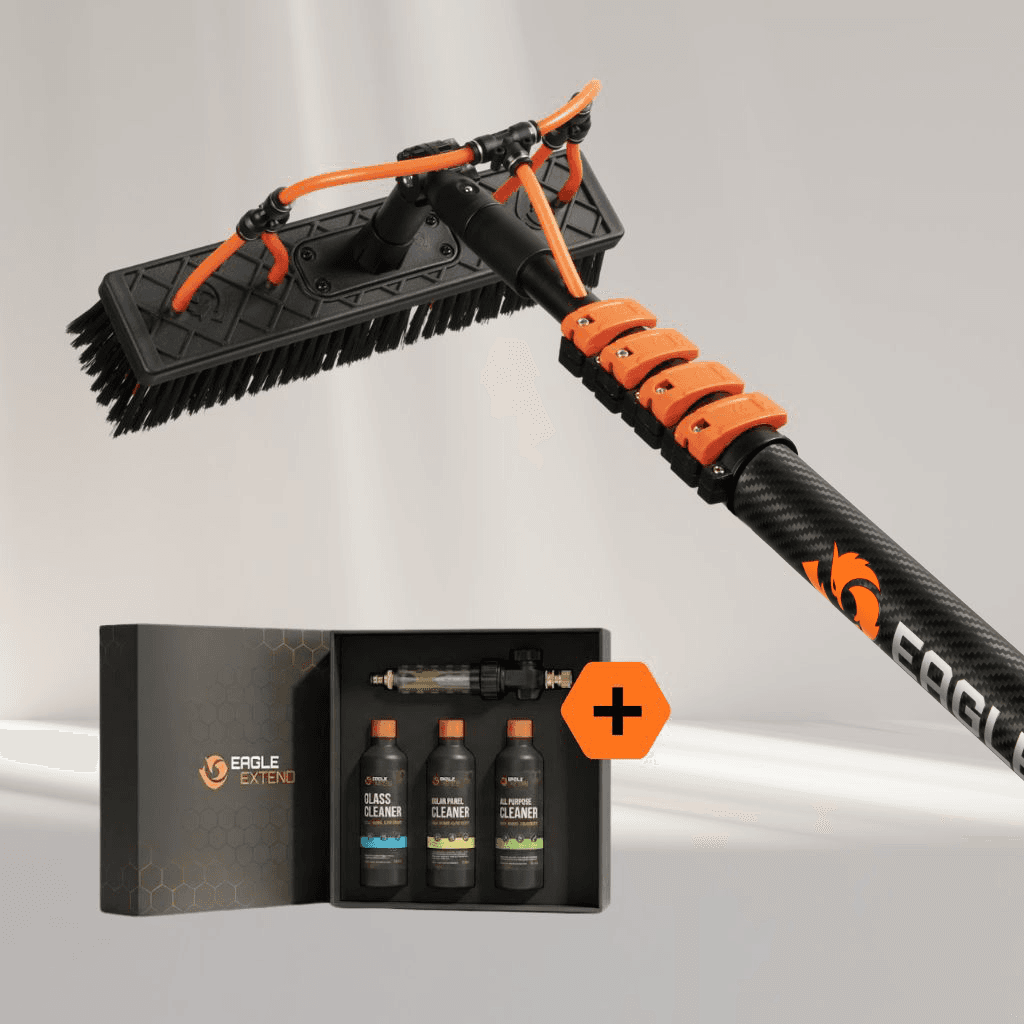
3K Full Carbon Supreme Water-Fed Pole
9, 10.2 and 12.05 m (working length 8.5–11.5 m) at just 1.6–2.3 kg. The stiffest choice for tall walls, dormers and solar panels. HexaLock® end adapter and a 5-year guarantee.
The MAX mark: the limit of your working length
Every section has a red MAX mark. It shows how far you can extend that section: beyond it, the overlap with the section below is too short and the pole loses stability. The working lengths in this article already take that into account. So if your calculation comes up a few centimetres short, extending further isn’t an option — you need the next size.
Still not sure? Get advice
The calculation gets you a long way, but sometimes there’s more to it: a house with different heights, an extension you can’t get round, or the plan to clean the gutter and solar panels as well. Try our buying guide: it asks about your job and preferred material, then recommends the right kit. For all six things to check when buying — from length to clamps and water feed — read how to choose a water-fed pole. And you’re always welcome to send us a photo of your house; we’re happy to help.
Clean high and upstairs windows from the ground
Get upstairs and dormer windows streak-free — without a window cleaner or a ladder.