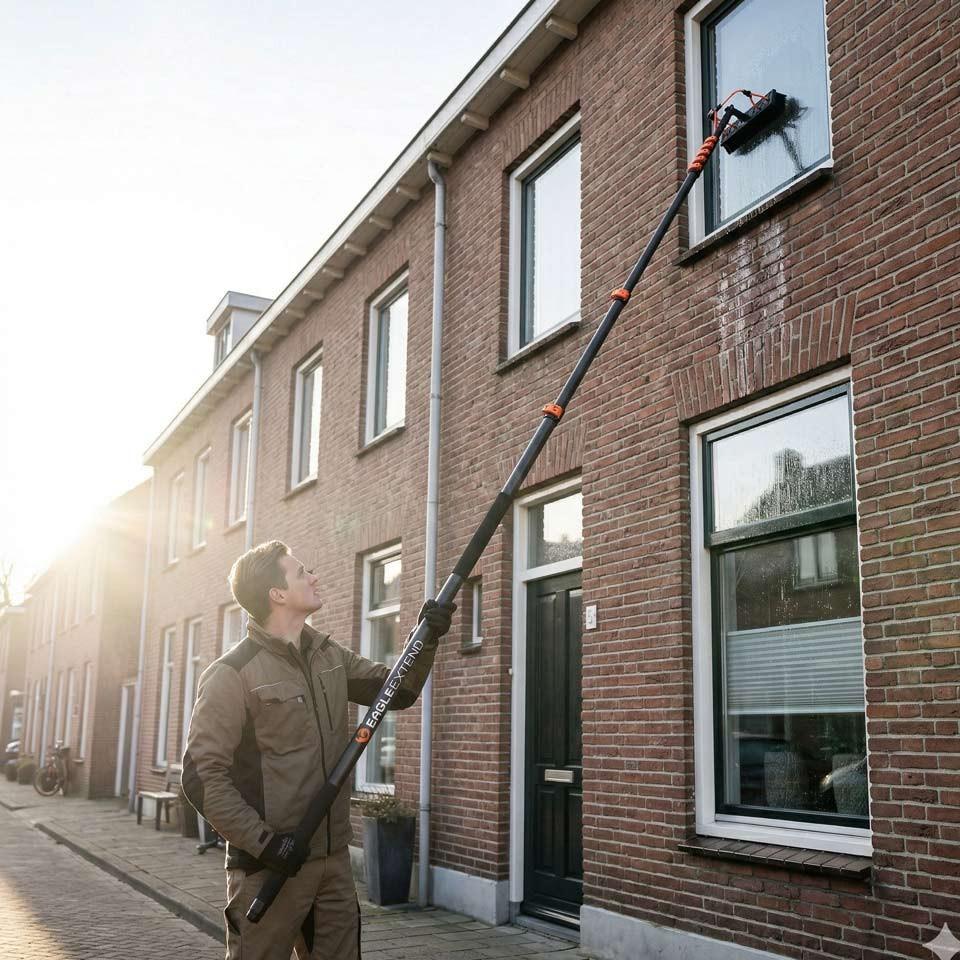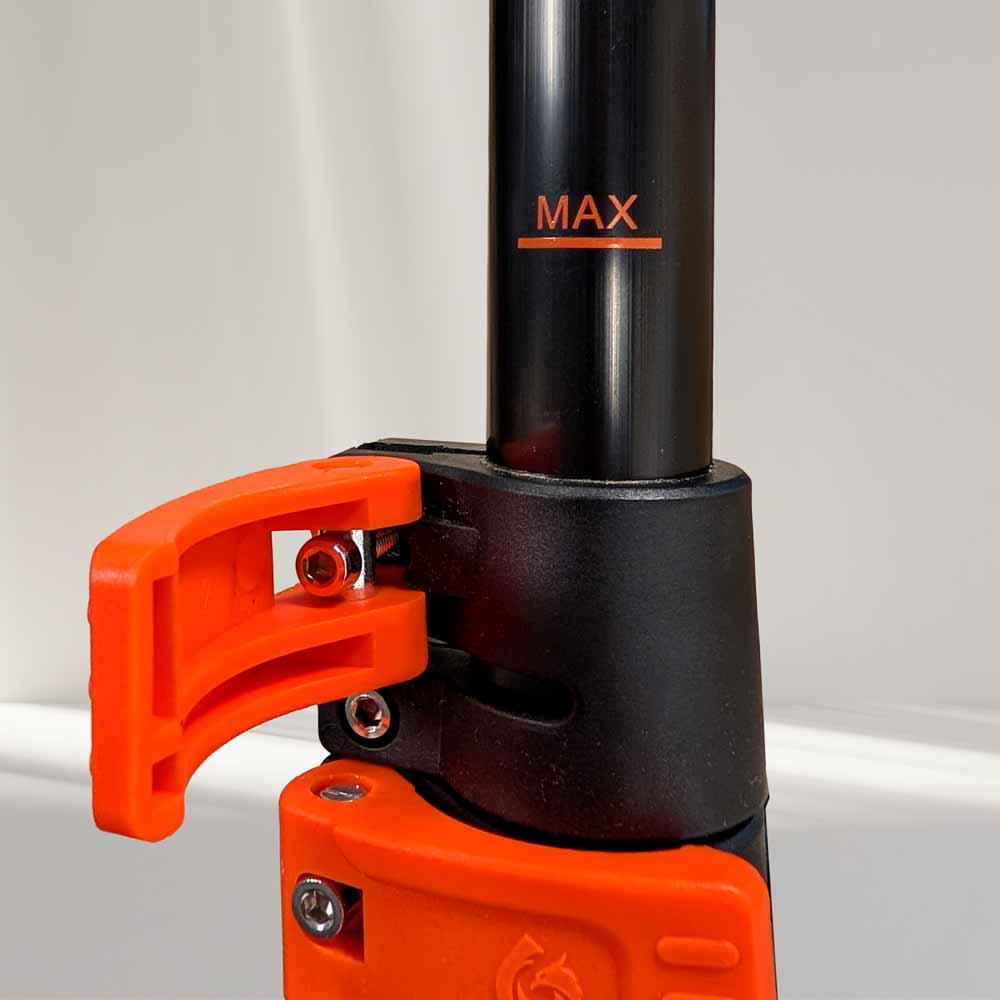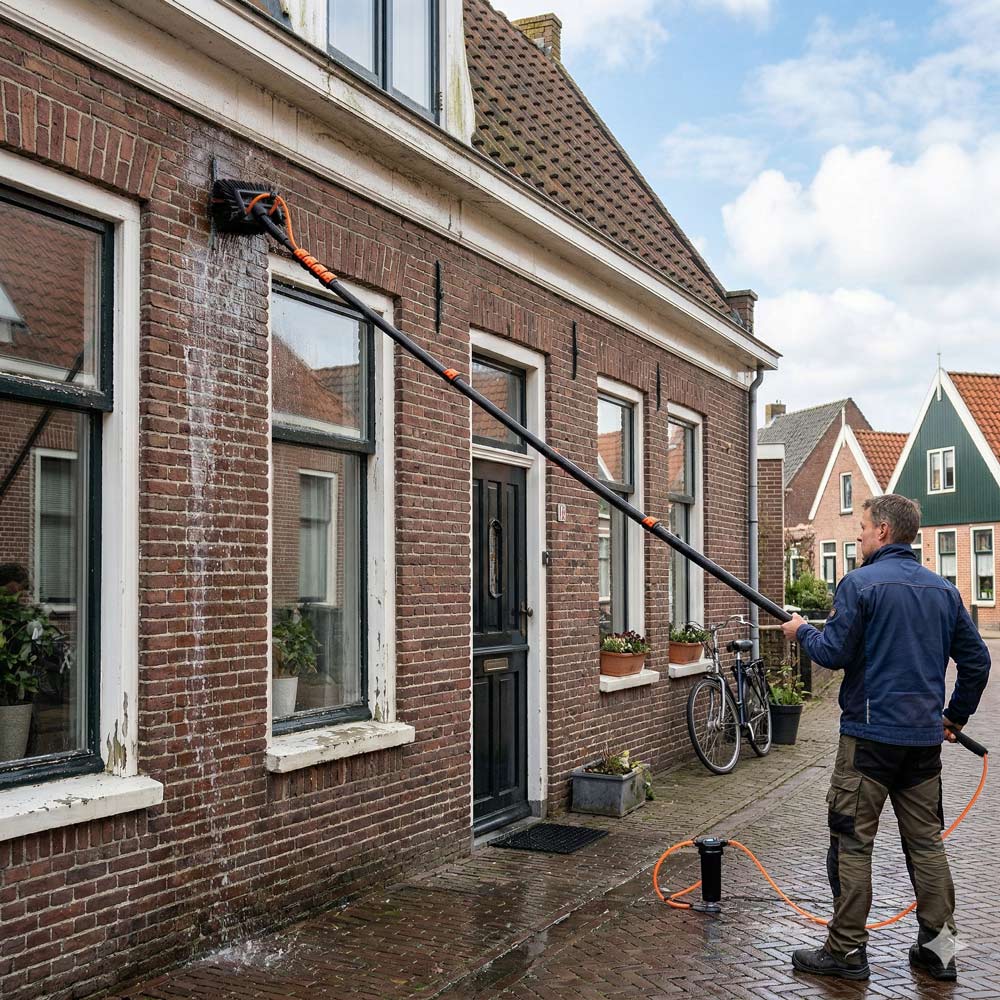
You can clean windows in winter as long as it isn’t freezing. Pick a dry afternoon a few degrees above zero, use lukewarm water and make sure the glass is dry before the temperature drops again in the evening. If there’s frost, or the water starts to freeze on the glass, leave it for another day.
Dirty glass is at its most obvious in the winter months. The sun sits low and shines through the window at an angle, picking out every streak and limescale mark. On the street side there’s also a grey film of road salt and spray thrown up by passing traffic.
This guide covers when to clean and when to wait, how to get water when the outside tap is switched off, which method works best in the cold, and how to put your kit away safely afterwards. With a checklist at the end.
Can you clean windows in frost? The rule of thumb
The short answer: not when it’s freezing. Water that freezes on cold glass leaves a thin layer of ice. You can’t squeegee it off, and the dirt freezes into it. A squeegee rubber won’t glide over ice either — it judders, and that’s exactly when streaks appear.
The best time is a dry afternoon a few degrees above zero. By then the glass has warmed up a little, any morning dew has gone and you still have a few hours of daylight. Keep an eye on the evening, too: if a frost is due early, everything needs to be dry by then — including frames and sills, where water likes to sit.
| Conditions | Advice |
|---|---|
| Frost or ice on the glass | Don’t clean; wait for a thaw |
| Around freezing, frost forecast for the evening | Better not; water on frames and glass may freeze |
| A few degrees above zero, dry, afternoon | Good time; use lukewarm water |
| Morning dew or condensation on the outside | Wait until the glass is dry |
| Rain or sleet | Postpone; the result won’t last |
Swipe sideways to see the whole table →
Why streaks show up more in winter
In summer you mostly look at a window head-on. In winter the sun is low and shines across the glass at an angle. That raking light reveals every streak, fingerprint and limescale mark you’d never have noticed in June. The glass isn’t dirtier — you just see it better.
Use that to your advantage. After cleaning, look along the glass at an angle with the sun behind you and you’ll spot straight away where another pass is needed. Try not to work facing directly into the low sun, though: it dazzles you, and you’ll miss exactly those spots.
Condensation: inside or outside?
Misty windows in winter are often condensation rather than dirt. If the moisture is on the inside, it’s down to ventilation and heating, and cleaning the outside won’t fix it; just wipe the inside with a cloth. If it’s on the outside, it’s usually morning dew that clears by itself later in the day. Wait for that: on misted glass you can’t tell whether you’re leaving streaks.
Road salt and grime on street-facing windows
If you live on a gritted road, your street-facing windows take a beating. Passing cars throw up a mix of salt, grit and an oily film from the road surface. On the glass it dries to a grey haze; on frames and sills it leaves a gritty line.
- Rinse thoroughly first Salt dissolves in water; grit doesn’t. Rinse generously first so the particles wash away before you start scrubbing with a washer or brush. That way you won’t drag grit across the glass.
- Then add cleaner Water alone struggles with the oily road film. A splash of Glass Cleaner in your bucket, or through the SoapFlow soap dispenser, loosens it. Go easy on the dose: too much soap leaves streaks of its own.
- Do the frames and sills too Salt left on the frame washes back onto your clean glass with the next shower. Clean frames, sills and ledges in the same session.
- Little and often While the roads are being gritted, the street side gets dirty faster than the back. A quick rinse of that one elevation every so often beats doing everything at once in spring.
Water, taps and soap in cold weather
Many outside taps are isolated and drained for the winter, and rightly so. Don’t turn yours back on for a single clean while frost is still about. Use an indoor tap instead — in the utility room, the garage or at the washing machine supply — with a suitable hose adaptor. You get lukewarm water straight away, which makes the job far more pleasant.
If you do open the outside tap on a mild day, drain it again afterwards: close the isolation valve indoors, then open the outside tap and let it run dry. Any water left in the pipe can freeze on the next cold night.

If you use a water-fed brush with the PureFlow water softener, you can carry on through the winter with one change: the softener no longer lives on the outside wall. There’s water in the filter housing, and you don’t want it to freeze. Disconnect it after cleaning, let it drain and store it indoors, away from frost. How the softener works, and when it’s worth having, is covered in streak-free window cleaning.
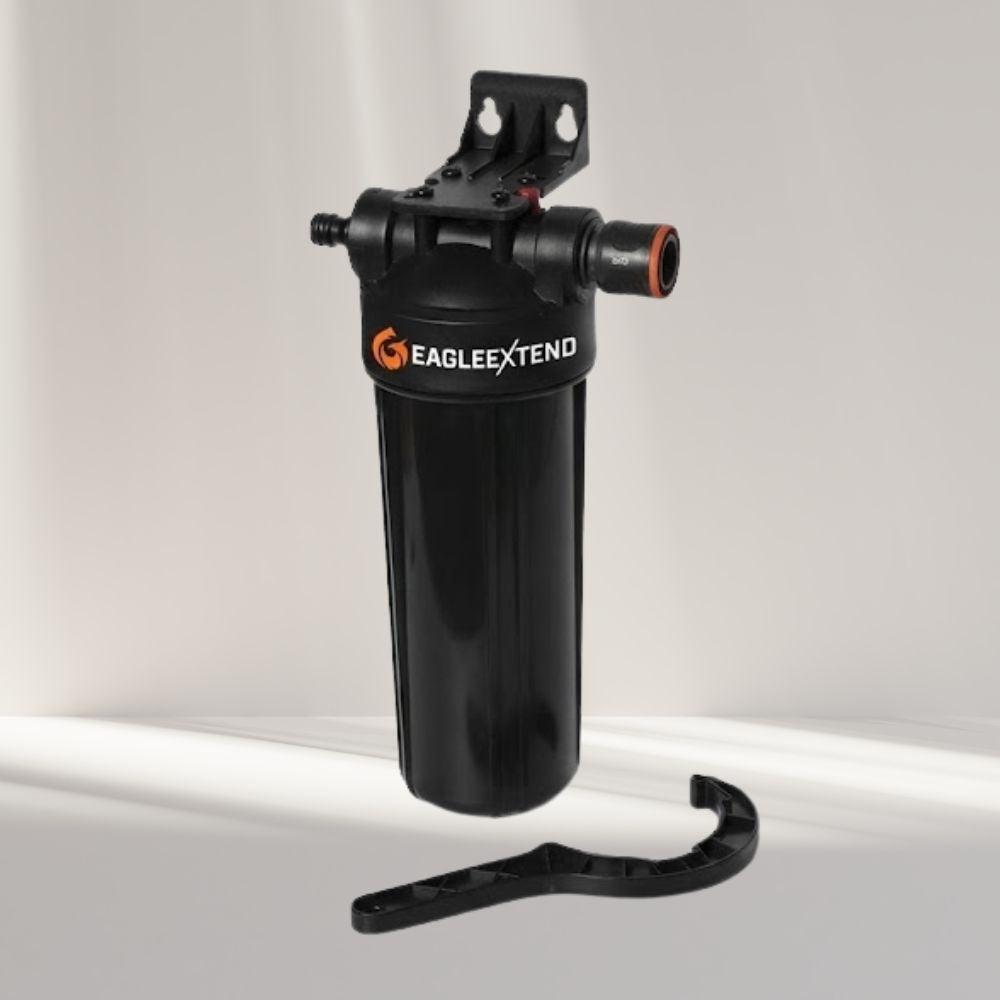
PureFlow water softener – Single Unit
Connects between your garden hose and your water-fed pole and fits any Gardena-type connector. The SoftResin cartridge filters limescale out of the water so you rinse with limescale-free water. Supplied with wall bracket, connectors and key.
Which method works best in the cold?
Both methods work in winter, but they behave differently. With a washer and squeegee you take the water off the glass straight away, so you don’t depend on how quickly it dries. That’s an advantage in the cold, because drying takes a long time in November and December. The Window Washer & Squeegee Set Pro combines both in one tool: wet the glass, give the pole a half turn in your hands and squeegee straight away.
With a water-fed brush and limescale-free water, you leave the glass to dry. That works in winter too, but only if it has time to dry before the frost sets in. So start early, and skip the north-facing side if it sits in shade all day and barely gets above zero.
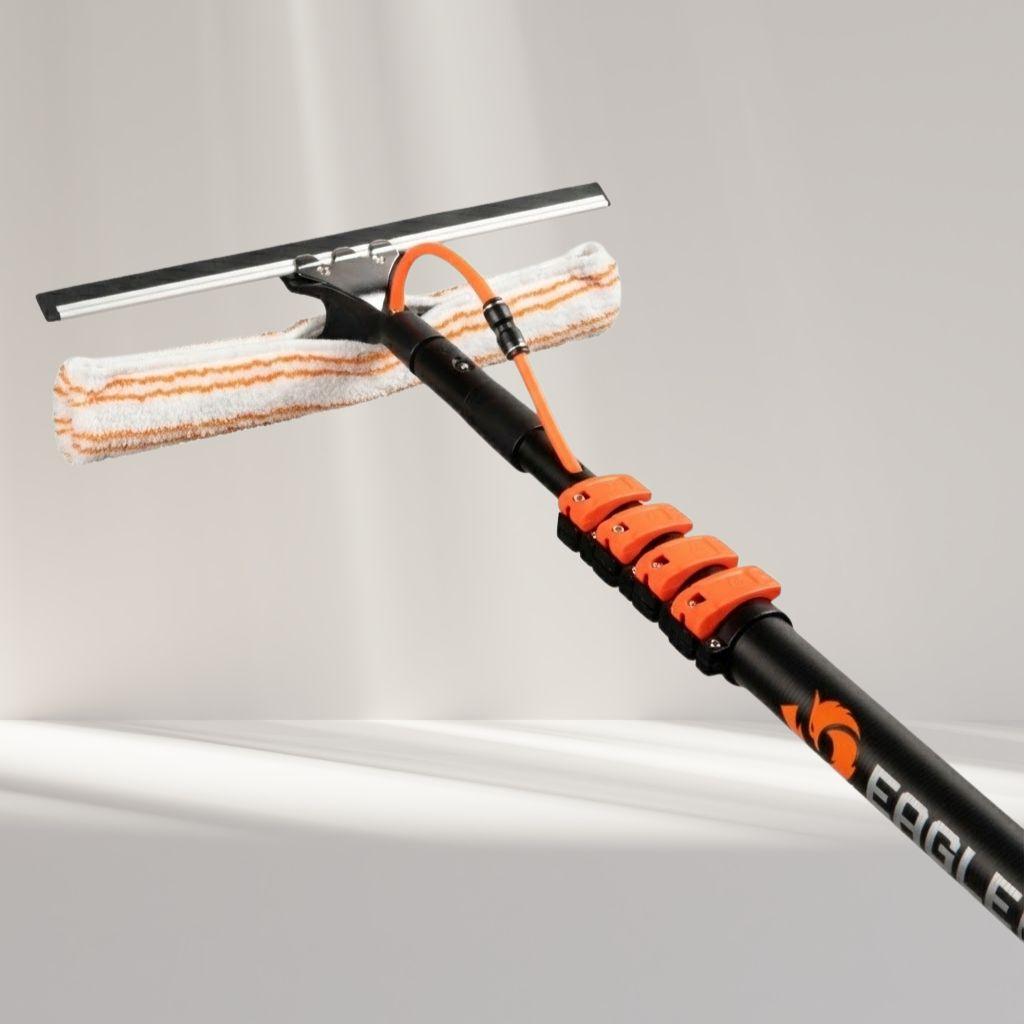
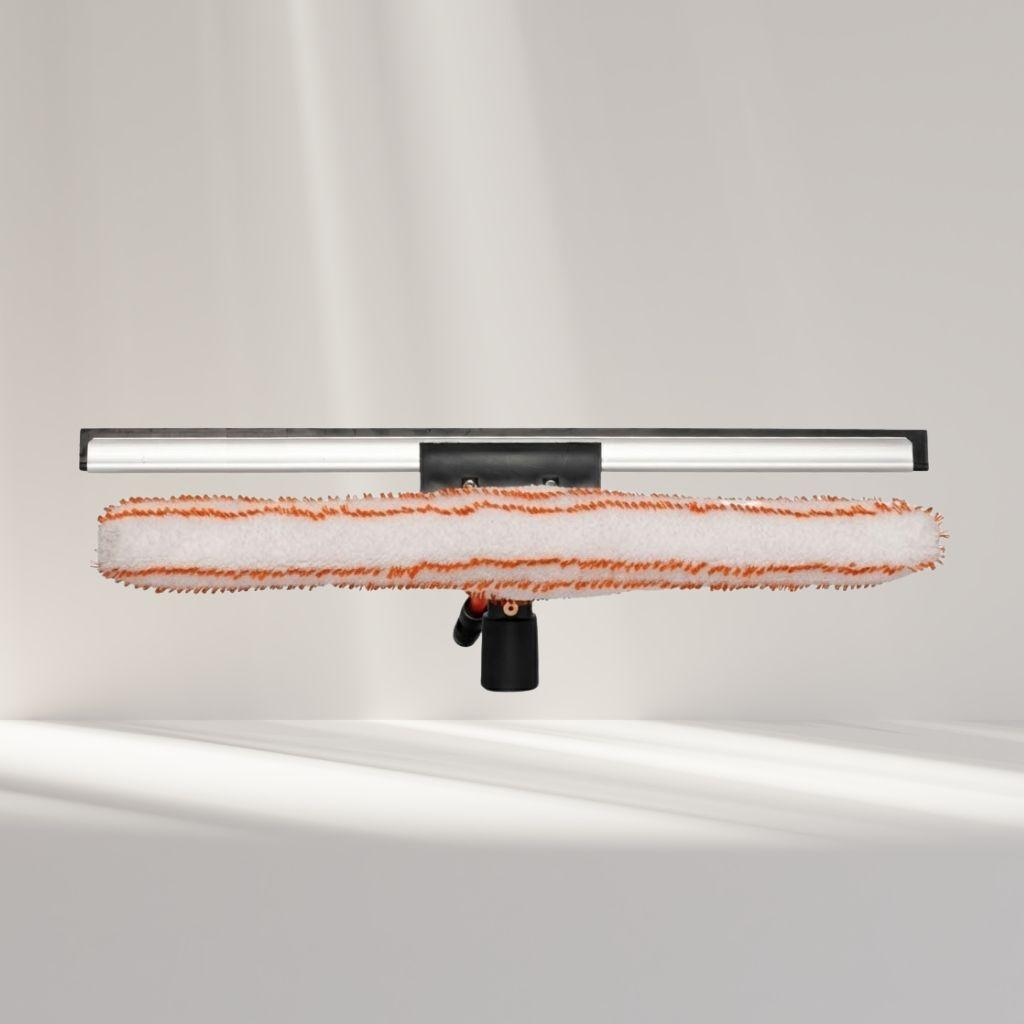
Window Washer & Squeegee Set Pro – HexaLock®
2-in-1 washer and squeegee with a microfibre sleeve. The HexaLock® one-click connector fits it to any Eagle Extend® telescopic pole in a single move.
Step by step: a winter window clean
How to do it
- 1Pick your moment
Check the forecast: dry, a few degrees above zero and no frost before evening. Start late in the morning, once dew and condensation have cleared, so you make the most of the brightest hours.
- 2Sort out your water
Use an indoor tap with lukewarm water, or only open the outside tap once it’s been thawing for a while. Fit the PureFlow and SoapFlow between hose and pole if you use them.
- 3Start on the street side
Rinse generously to clear salt and grit, do the frames and sills, and only then apply cleaner.
- 4Work from top to bottom
Clean in overlapping strokes from the top down. For upstairs windows, work from the ground with a telescopic pole; why that’s safer than a ladder on slippery winter ground is explained in cleaning upstairs windows without a ladder.
- 5Squeegee or rinse
Squeegee stroke by stroke and wipe the blade each time — or rinse with limescale-free water and leave it to dry. Then check the glass at an angle against the light.
- 6Drain everything
Let the hose and pole drain completely, shake out the brush and disconnect the PureFlow. Drain the outside tap again if you used it.
Afterwards: keep everything frost-free
The pole itself copes with frost. Aluminium and carbon don’t mind the cold, but water left in the hose, jets or brush expands as it freezes. So after every winter clean, drain the pole properly: hold it at an angle with the brush end down until nothing more comes out. Do the same with the garden hose, and store everything somewhere frost-free if you can. How to get your pole fully ready for winter is covered in water-fed pole maintenance.

Short days: plan ahead
In winter you only get a few usable hours a day. Don’t try to do everything at once. Tackle one or two elevations per session, starting with the street side where the road salt builds up. Save the full round for early spring, when the days draw out and temperatures settle. For the right reach and the right set, see cleaning high windows.
Snow on the ground? Then the glass can wait. On a clear winter’s day, your time is better spent on the roof: see how to remove snow from solar panels.
Checklist: window cleaning in winter
- Dry, a few degrees above zero, no frost before evening
- No dew or condensation on the outside of the glass
- Lukewarm water from an indoor tap, never hot water
- Outside tap on only during a thaw, then drained again
- Street side: rinse thoroughly first, then add cleaner
- Use Glass Cleaner sparingly
- Clean frames and sills as well
- Drain hose, pole and brush afterwards
- Disconnect the PureFlow and store it frost-free
Clean high and upstairs windows from the ground
Get upstairs and dormer windows streak-free — without a window cleaner or a ladder.