Windows dry streak-free when nothing is left behind on the glass as the water evaporates: no limescale and no soap. There are two ways to get there. Either you squeegee the glass dry, or you rinse with softened, limescale-free water so that far less is left behind when it dries.
You’ve scrubbed the windows, rinsed them well, and still: once they’re dry, there’s a white haze, little spots and streaks. It’s rarely your technique or your brush. It’s the water you rinsed with. This guide explains what’s in tap water, why it shows up as it dries, and which of the two routes suits your windows.
Why tap water leaves hard water spots
Tap water is never just water. It carries dissolved minerals — limescale above all. While the water is on the glass you can’t see them: everything is dissolved and the drop is clear. But once the water evaporates, the minerals stay behind, exactly where the last drop was.
That explains the typical pattern. You rarely get an even haze. Instead you see edges, trails and dots at the bottom of the pane and along the frame, where the run-off collects and dries last. The harder your water, the more minerals in every drop and the clearer the marks.
- Limescale and minerals stay behind after evaporation as white spots or a dull haze on glass, plastic and paintwork.
- Soap residue is the second cause of streaks. Rinse too little and a thin film of soap stays on the glass and attracts dust.
- Rainwater naturally contains hardly any limescale, so it dries much cleaner. But you need a pump or another pressure source to push it through the hose and pole.
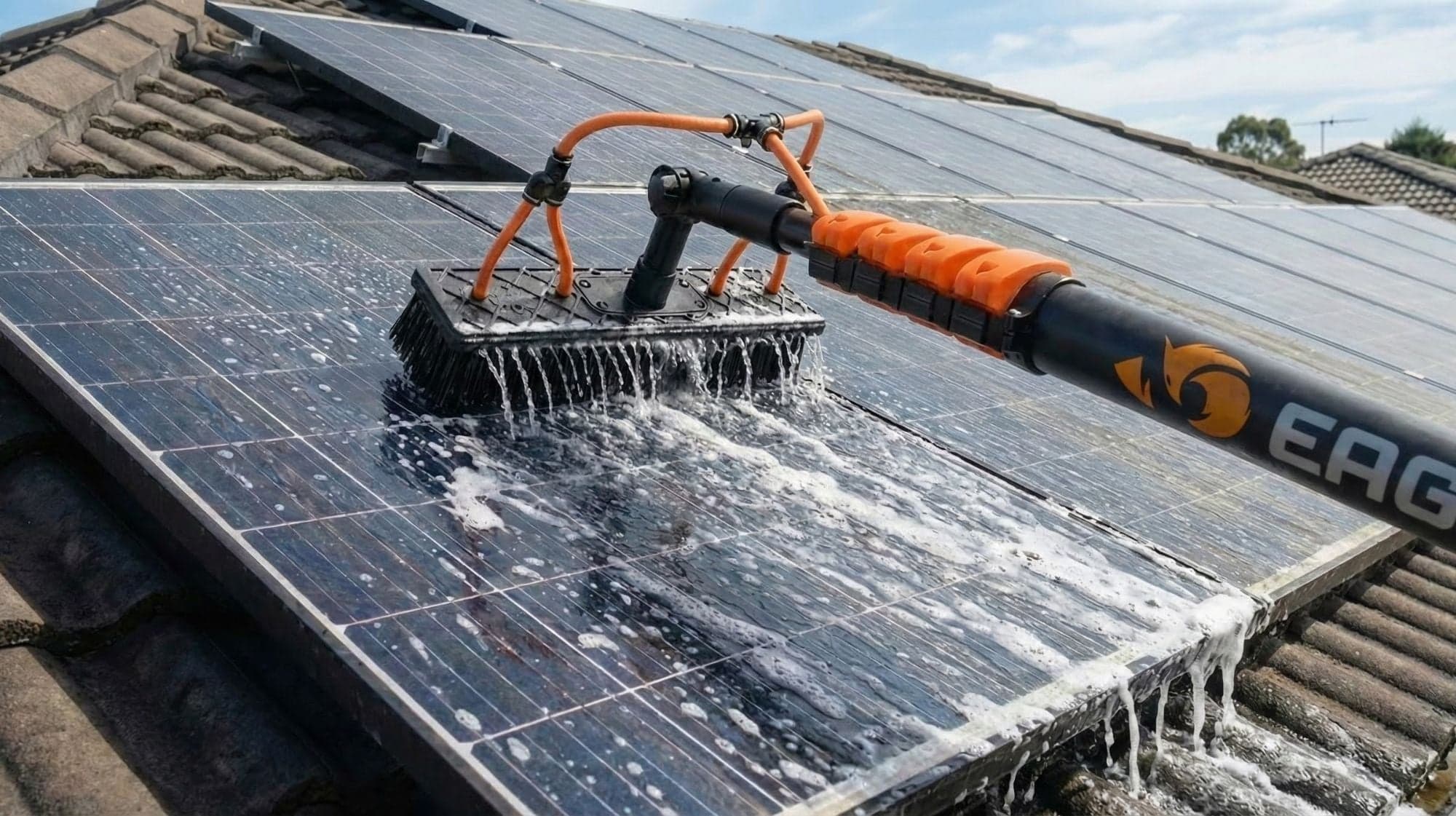
For DIY cleaning, tap water works perfectly well as long as you rinse thoroughly and squeegee afterwards. If you want a clean finish without squeegeeing — and on high windows and solar panels that’s often the only practical option — the limescale has to come out before the water reaches the surface.
What does a water softener do?
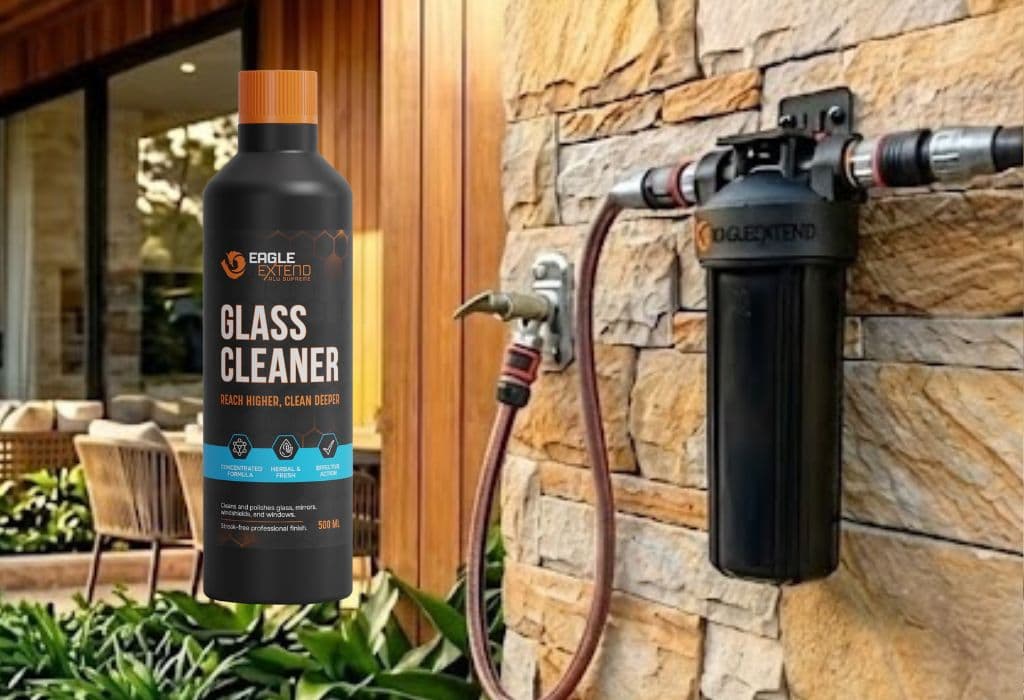
The PureFlow in-line water softener is a filter housing that sits between your garden hose and your water-fed pole. Inside is a SoftResin cartridge: a resin cartridge that takes the limescale out of the water. What comes out the other end is softened, limescale-free water that leaves far fewer marks as it dries.
Every unit has a standard click-on hose connector (Gardena-compatible) and works straight out of the box — no extra connectors, no electricity, no pump. If your hose uses a different connector system, you may need an adapter. The softener runs entirely on normal mains pressure (around 3–5 bar), the same pressure our telescopic poles are built for.
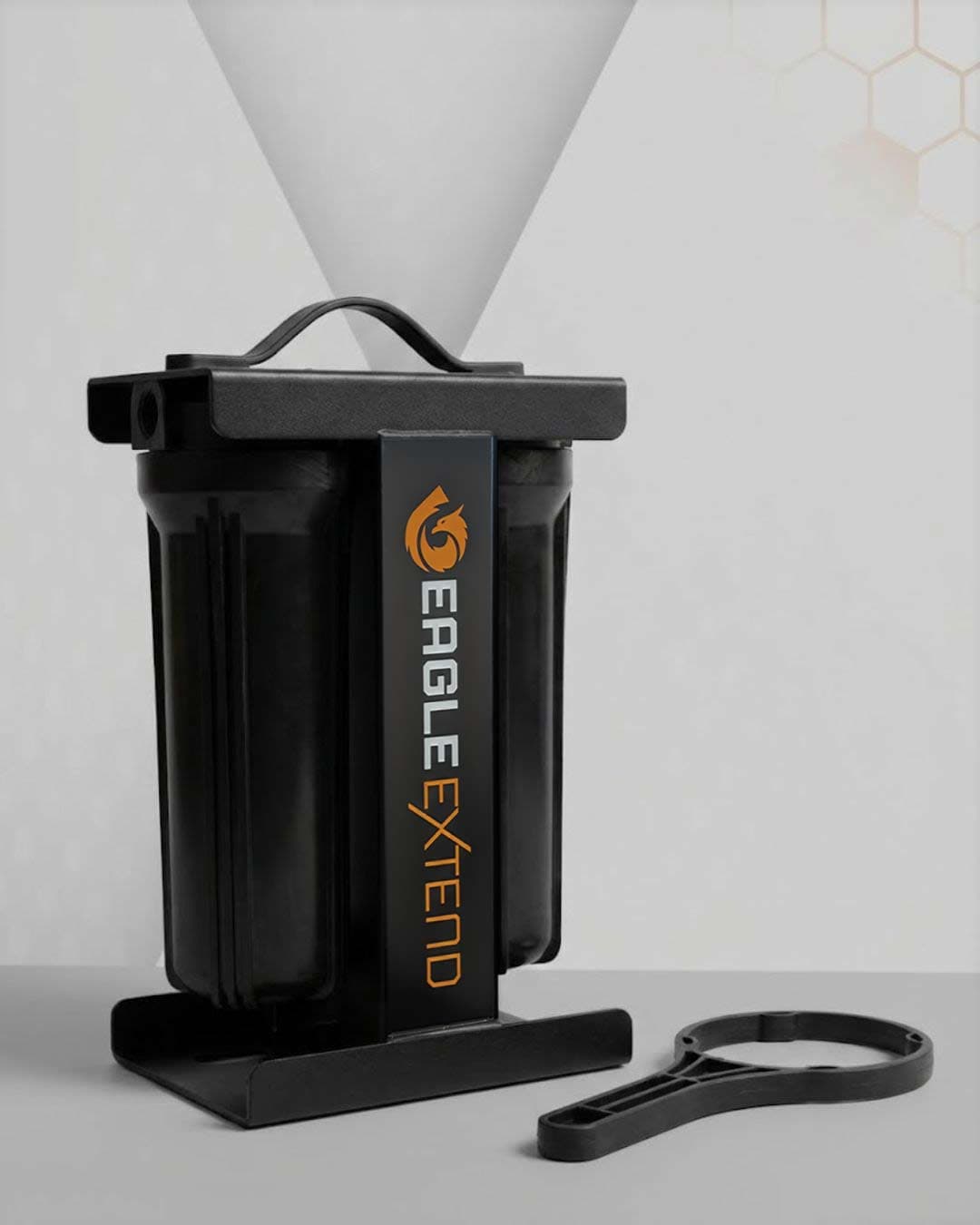
| Unit | Cartridges | What you get | Best for |
|---|---|---|---|
| Single Unit | 1 × SoftResin | Wall bracket, connectors and filter key | Homeowners: the windows and solar panels of one house |
| Dual Unit | 2 × SoftResin | Floor stand and sturdy carry handle | Larger homes, longer cartridge life, frequent use |
| Jumbo | 2 × SoftResin | Trolley, water hardness display, adjustable to your local water hardness | Professional window cleaners working full days |
Swipe sideways to see the whole table →
The difference is mainly capacity and convenience. You hang the Single Unit on the wall and forget about it. The Dual Unit lasts longer thanks to its two cartridges and stands steadily on the ground. The Jumbo sits on a trolley, has a water hardness display and can be set to the hardness of your local water. Replacement SoftResin refill cartridges are sold separately, including as a pack of 2.
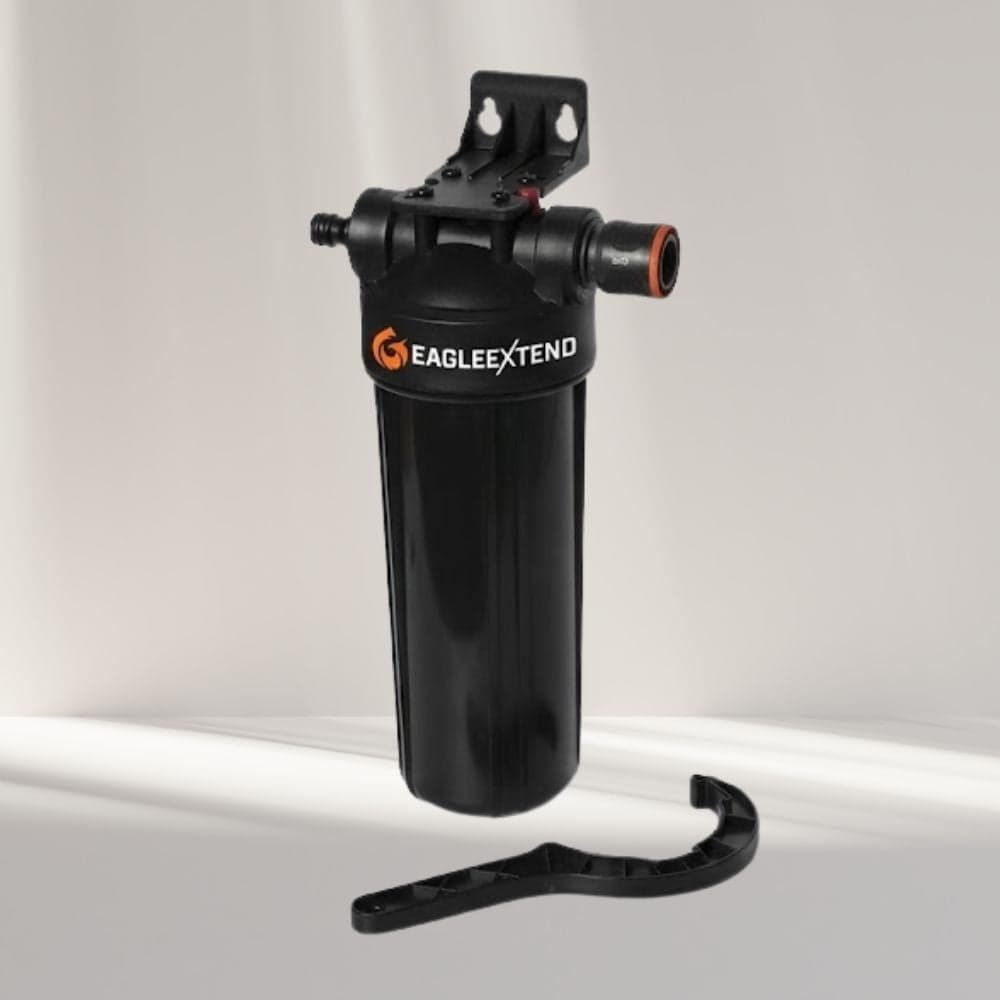
PureFlow In-Line Water Softener – Single Unit
Filter housing with SoftResin cartridge, wall bracket, connectors and filter key. Click it in between your garden hose and pole and rinse with limescale-free water.
Softened water vs pure water: does soft water leave spots?
Many professional window cleaners use pure water, made with reverse osmosis or deionisation. That water contains almost no dissolved solids at all. PureFlow is not a pure-water system. It’s a water softener: it removes the limescale — the hardness minerals that cause the typical white spots — while other dissolved substances stay in the water.
So does soft water leave spots? Far fewer limescale spots than tap water, and on most windows and solar panels you can simply let it dry after a thorough rinse. But we won’t promise a perfect finish on every pane. If you still see faint marks once the glass is dry, finish it with a squeegee — on windows that always works.
Squeegee or let it dry?
The traditional method still works very well on windows: wet the glass with a washer, then squeegee it dry stroke by stroke, wiping the squeegee blade on a clean cloth after every stroke. Skip that and you drag dirty water back across the glass — and get exactly the streaks you were trying to avoid.
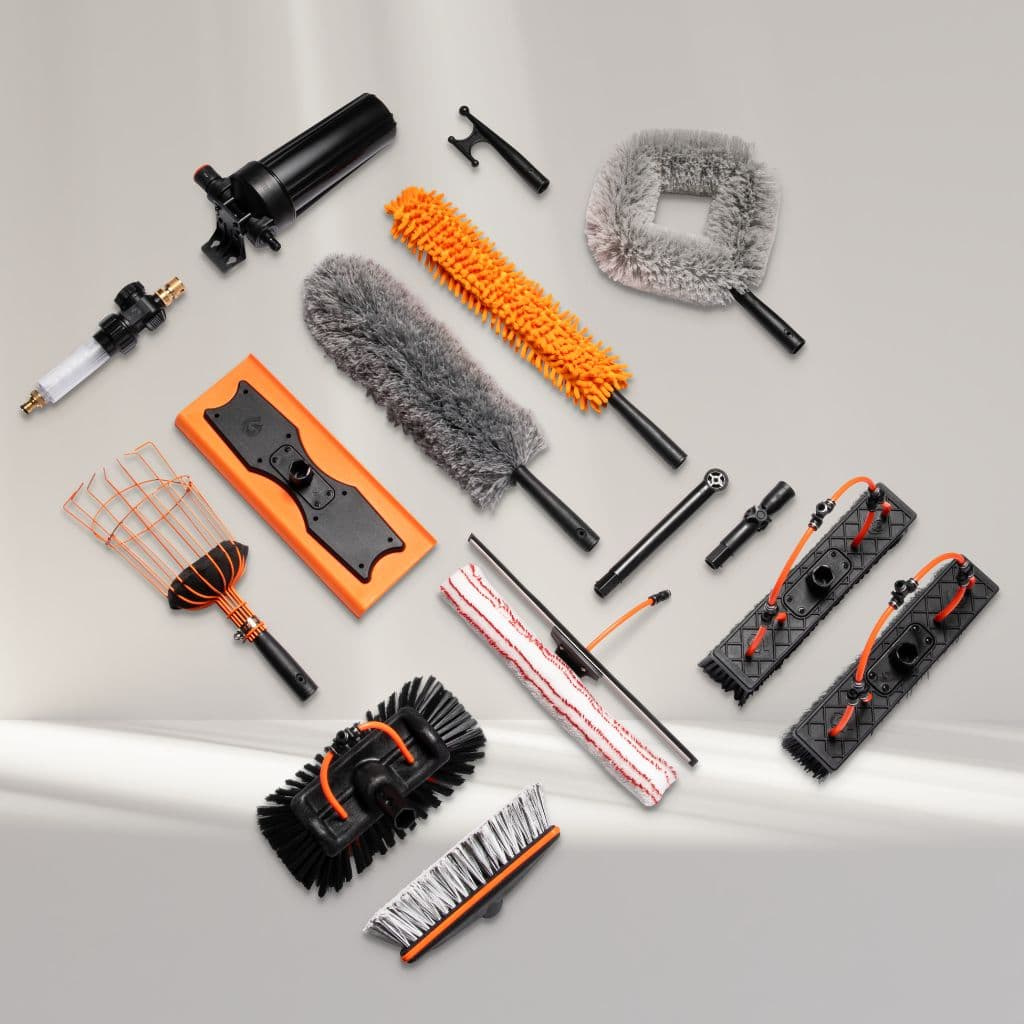
The Window Washer & Squeegee Set Pro does both with one attachment: wash the glass, turn the pole slightly in your hands and squeegee the window dry. No swapping, no second tool on the pole. The HexaLock® connection stops the squeegee from twisting, which makes all the difference at height.
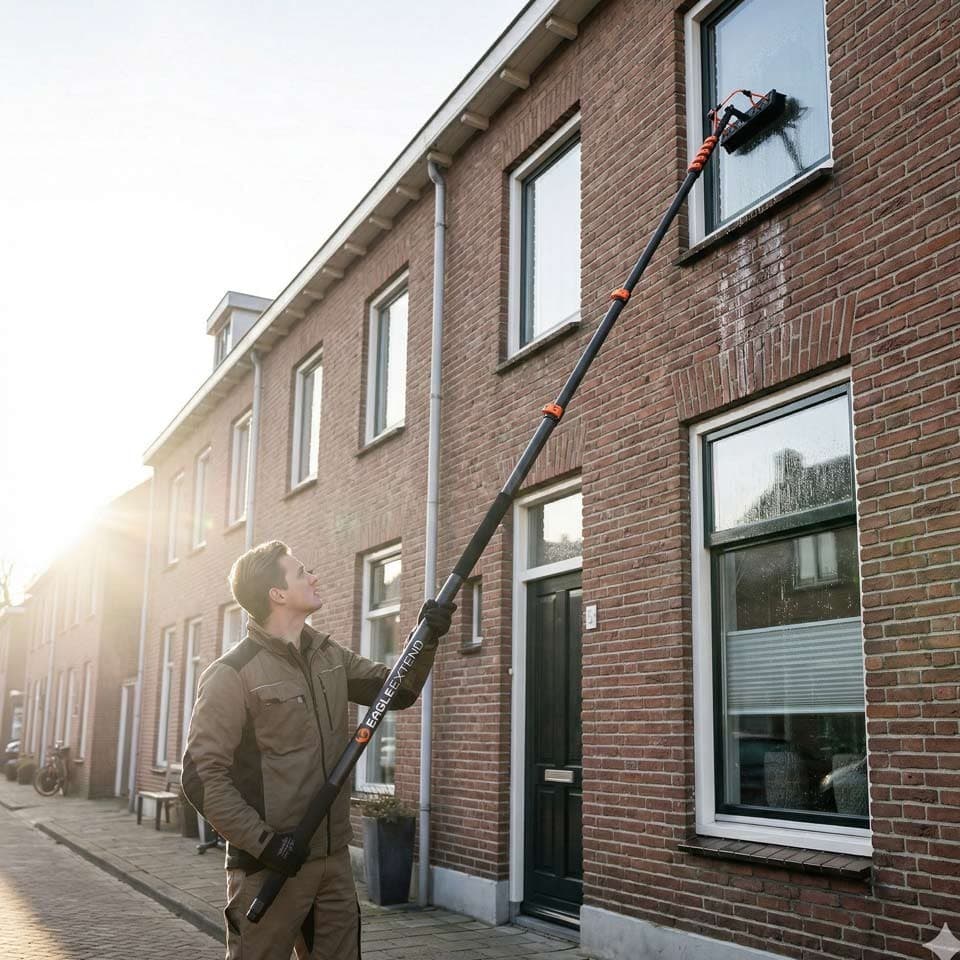
Squeegeeing does have its limits, though. At around 12 metres you’re standing a long way from the wall and the right blade angle is hard to find — it takes practice. Our stiff carbon fibre poles help. If you find it too awkward, switch to rinsing with limescale-free water using the same pole and let the water do the work.
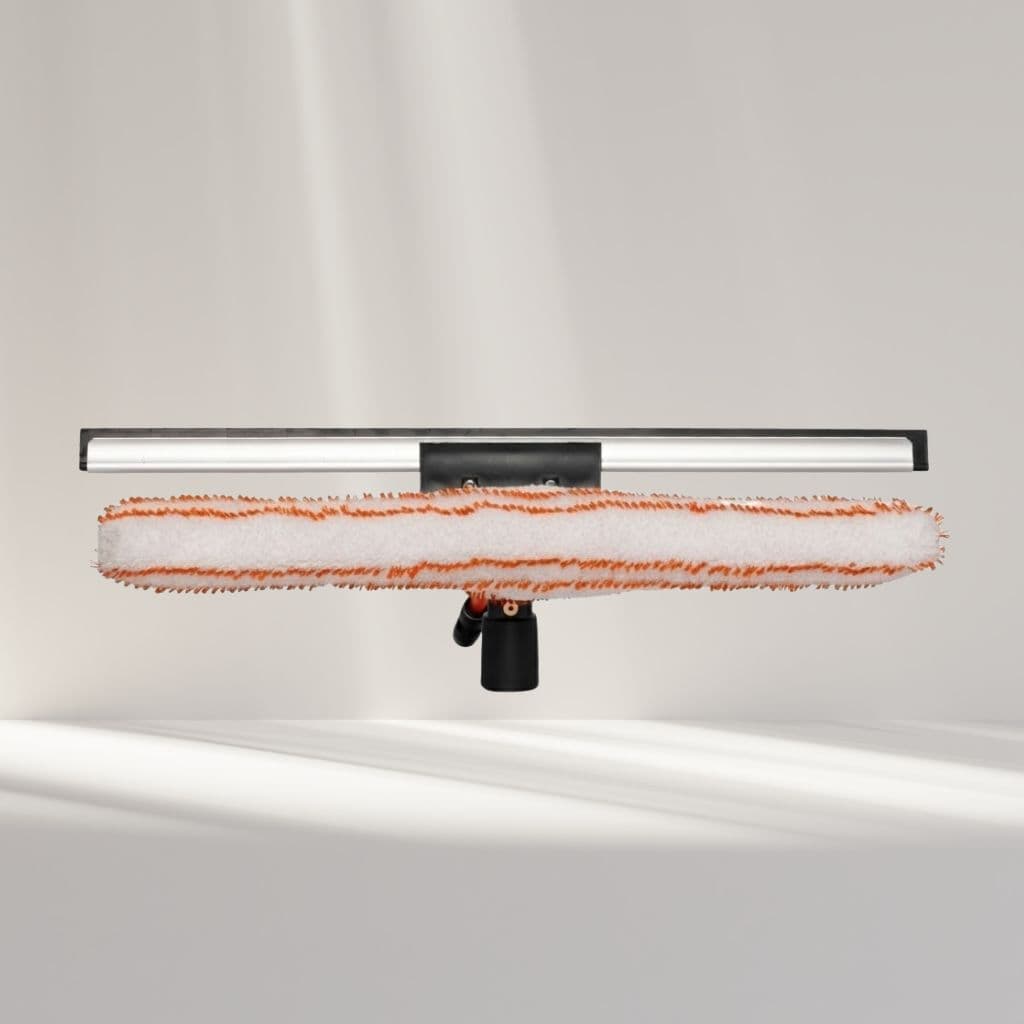
Window Washer & Squeegee Set Pro – HexaLock®
A 2-in-1 washer and squeegee with a microfibre sleeve. Wash and squeegee without changing attachments — from the ground, without a ladder.
Soap: Glass Cleaner and the SoapFlow dispenser
If you use a water-fed brush with PureFlow, you usually don’t need soap — limescale-free water plus the action of the bristles does the cleaning. Only really greasy windows, cooking grease by the kitchen or a heavily soiled wall need a cleaner to loosen the dirt.
That’s what Glass Cleaner is for: a concentrated glass cleaner (500 ml) that you dose sparingly. If you work with a washer and bucket, a splash in the water is enough. Don’t use harsh products — they attack the rubber of your squeegee.
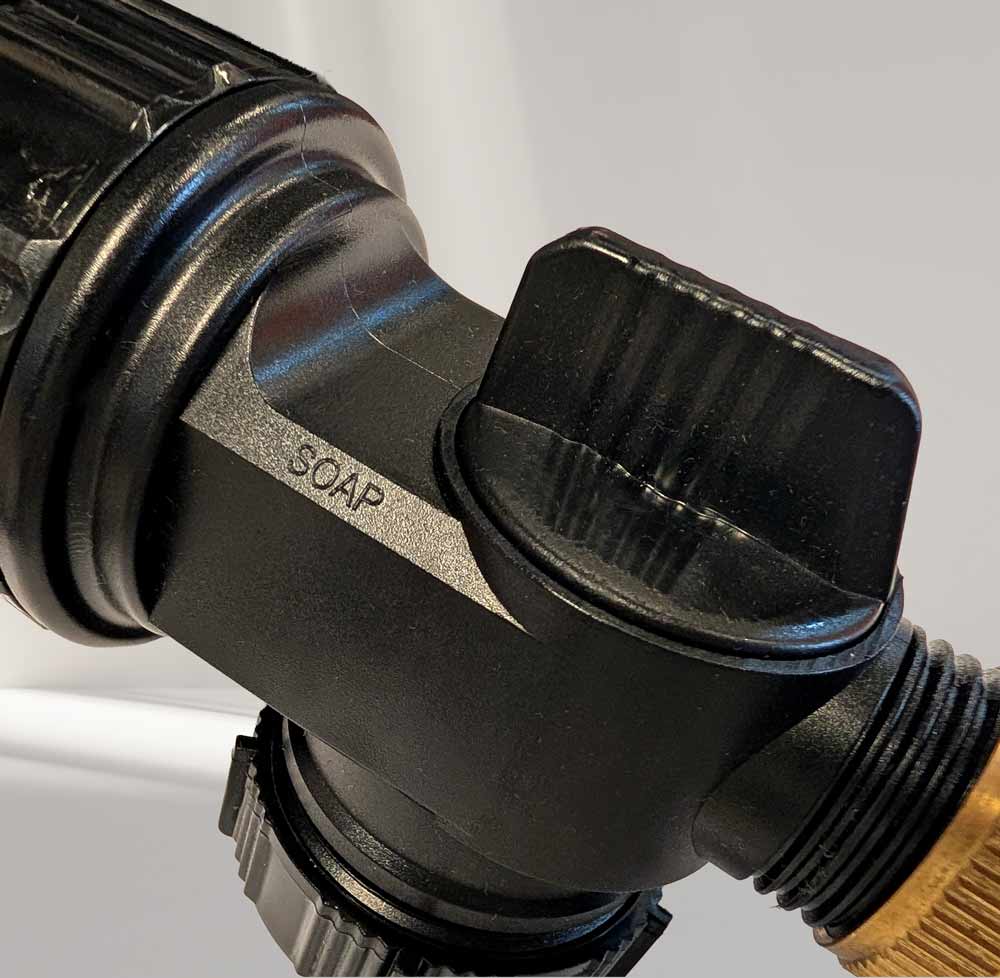
The SoapFlow soap dispenser fits between your garden hose and the hose of your pole. The control lets you dose precisely and switch between soap and clean water in one move — without filling your whole garden hose with soap, as many other dispensers do.
A routine that works every time
From dirty window to streak-free finish
- 1Connect your water line
Garden hose → SoapFlow (optional) → PureFlow → ball valve → water-fed pole. Everything uses the same Gardena-compatible click-on connectors, so it simply clicks together.
- 2Rinse off loose dirt
Start at the top and wet the pane. You want dust, cobwebs and grit gone before a brush goes over the glass — that helps prevent scratches.
- 3Add soap or brush straight away
Greasy windows: set SoapFlow to SOAP and let it work briefly. Normal dirt: brush with water straight away and let the bristles do the work.
- 4Brush from top to bottom
Calm, overlapping strokes. Finish one pane at a time so the soapy water doesn’t dry while you’re working further along.
- 5Rinse generously
Switch back to clean water and rinse thoroughly — this is where most people cut corners. Every trace of soap has to come off.
- 6Let it dry or squeegee
Rinsing with limescale-free water from PureFlow? Usually you can just let it dry, and squeegee only where marks remain. Rinsing with tap water? Squeegee the window dry straight away and wipe the rubber after every stroke.
Five mistakes that still cause streaks
- 1Working with soap in full sun. With the traditional method, the soapy water dries too fast and spots are almost certain. Work in the shade or early in the day. Limescale-free water from PureFlow copes much better with sun, because there’s far less limescale to leave behind — but soap still needs rinsing off before it dries.
- 2Not rinsing enough. After limescale, soap residue is the main cause of streaks. Better to rinse ten seconds too long than ten seconds too short.
- 3A dirty microfibre sleeve. A soaked or gritty sleeve spreads dirt instead of picking it up. Rinse it out as you go and replace it when it’s worn.
- 4Using household cleaners. Washing-up liquid and all-purpose cleaners often leave a greasy film that attracts new dirt. We strongly advise against them on solar panels.
- 5Using high pressure. More pressure doesn’t mean better cleaning. Normal mains pressure through the pole is plenty; a pressure washer can damage rubbers and seals.
Which set-up suits you?
Do you clean the windows of an average house a few times a year, and are you happy to squeegee? Then a pole, the washer and squeegee set and some Glass Cleaner will get you a long way. Got high windows, solar panels or walls you simply can’t reach properly with a squeegee? Then a water softener quickly pays for itself in time and frustration.
Not sure which pole and attachment to combine? Try the Pole Finder or read Which brush do you need for your water-fed pole?. All cleaners and water softeners are in Cleaners & Water Softeners. Every Eagle Extend® telescopic pole comes with a 5-year guarantee.
Conservatory, veranda and patio cover roof cleaning
Let the light back through your glass or polycarbonate roof — without climbing onto it.